

In May 2025, home sales across Canada rose 3.6%, the first month-over-month gain in six months. Canada's property management sector is worth $9.8 billion in 2025, with 35,145 businesses operating nationwide. Pent-up demand, borrowing costs and the usual seasonal patterns are all expected to make spring 2026 even busier. Your phones will ring; that much is certain. What matters is whether your team can keep up.
The Real Cost of an Unanswered Call
In May, each call that goes unanswered is business you may not see again. Buyers who get a busy signal simply dial the next agent on their list. Would-be tenants who cannot reach your leasing office will lease from someone else. These people are motivated and ready to move, and their patience is short. Property managers face extra pressure in spring, too: it is the height of moving season, many leases end around the same time, and maintenance requests pile up. When responsiveness is the whole game, none of this can be handled if callers never get through.
How a Call Queue Works

A Call Queue keeps incoming callers waiting in an organized line until an agent is free to pick up, so they stay connected rather than landing in voicemail or hearing a busy tone. Queues can be tailored in many ways, and there are several types to choose from:
- Round Robin sends each caller to whichever agent has gone the longest without a call, spreading the work evenly.
- Ring All rings every free agent at the same moment so the call is answered as fast as possible.
- Linear Hunt tries agents in a set order, which works well when people handle specific kinds of enquiries, such as residential sales on one side and commercial leasing on the other.
- Linear Cascade moves the call through successive groups of agents until someone answers, a good fit for bigger organizations.
- Call Park holds a caller until any phone on the system picks the call back up, with both Static and Dynamic versions for extra flexibility.
During the busiest weeks, the Callback feature may be the most useful of all. Once wait times hit the queue's set maximum, callers can either keep holding or ask to be called back. In both cases they keep their spot, and when their turn comes the system automatically links them with the next free agent.
Texting and Reports in One Place
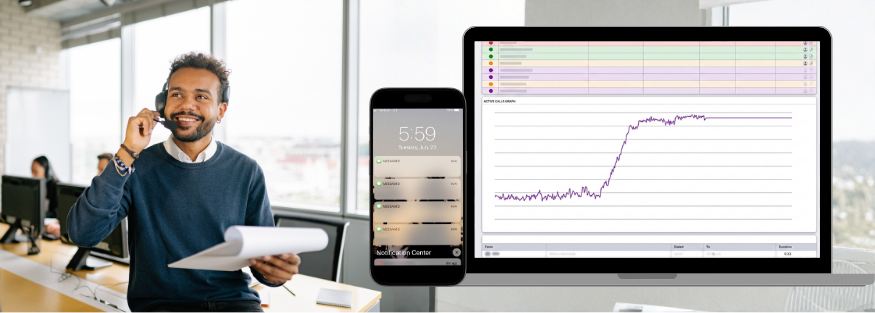
Call Queues handle more than voice. SMS is part of the queue system itself, so a text that comes in is passed to a free agent through a managed session. If a client cannot get through by phone, they can text your business number, and the conversation stays in a tracked queue instead of vanishing into someone's personal phone. Choosing to text instead of call never costs you a lead.
Supervisors can see both channels clearly. Turn on Statistics and the queue produces reports on call activity, while SMS contributes two more measures: SMS Volume and SMS Average Handle Time. So if a rush hits on Saturday morning and your people are stretched, you do not learn about it on Monday. You can watch it unfold in real time and respond.
Pairing Call Queues With Agentic Voice AI

No matter how well a queue is set up, it can only do so much. When more calls arrive than your agents can take, Agentic Voice AI takes over where the queue runs out. It can manage thousands of inbound calls at once, direct callers in real time, take messages and book appointments without help.
Imagine a hectic Saturday morning in May. The Call Queue is passing callers to whoever is free, and Agentic Voice AI is booking showings and recording maintenance requests at the same time. By the time your agents finish their current calls, the next batch has already been looked after. Nothing was missed, and nobody ended up in voicemail.
No Missed Callers, No Lost Leads

Spring is unforgiving when it comes to missed calls. With the phones ringing nonstop and every caller a possible client, a busy signal is more than an annoyance. It is a deal walking out the door.
Callers stay in the game. There are no busy signals or voicemail dead ends. Call Queues keep each caller waiting and connect them to the right agent, so leads do not get away.
Long waits do not cost you leads. With Callback, a caller keeps their place in line and is reconnected automatically once an agent is available.
Work is shared fairly. Calls are spread evenly, so one agent is not buried while others have nothing to do.
Managers see every channel. Live reporting covers both calls and SMS, so a surge never takes leadership by surprise.
Get Ready Before the Rush
Missing a call in May costs more than one conversation. It can mean losing a client, a lease, a listing and maybe a future referral. Handling the spring market takes the right tools set up before things get hectic, and the time to do that is now, while your team still has room to put something new in place.
With Call Queues, every caller is acknowledged, every lead is captured and every tenant question gets the professional response your brand deserves. This May might be your busiest one so far, and the businesses that do best will be the ones that prepared before the first call arrived. Learn more about our phone system for real estate companies or get in touch with RBI Cloud Connect.
Frequently asked questions
What happens when a Call Queue's wait time gets too long?
Once wait times reach the queue's maximum, callers can choose to keep holding or request a callback. Either way they keep their place, and the system connects them to the next available agent when it is their turn.
Can clients text my business number instead of calling?
Yes. SMS is built into the queue system, so incoming texts are routed to available agents through a managed session and stay in a tracked queue.
Which queue type suits agents who specialize?
Linear Hunt routes callers in a predefined order, which works well when agents handle specific inquiry types such as residential sales versus commercial leasing.