


Put the question to a property manager directly: what in this building still runs over copper? The usual reply is a hesitant "most of it, probably." The elevator phone comes to mind right away, and possibly the fire panel. Past that point, things get vague. There might be a door entry system put in by a contractor who has since closed shop. There could be a fax line in a back room that no one has used in years, yet the alarm company wants it kept live. Perhaps there is an emergency phone by the pool, added during a renovation ten years back, that appears on no current equipment list at all.
Situations like this are completely normal. Over fifteen or twenty years, a building picks up system after system, each installed by a different vendor at a different time, and rarely does any one person maintain a master record of all of it.
UC Analog: Ready to Replace Every Line You Can Find
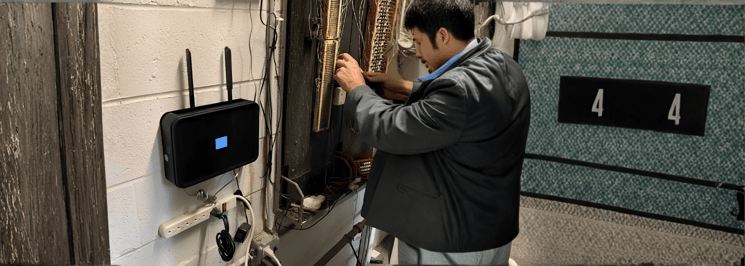
UC Analog takes the place of a copper line using a device, plugging straight into the analog equipment you already have, whether that is a fire panel, an elevator controller, a gate system or a fax machine. Nothing needs to be rewired and the equipment itself stays put. The compact UC Analog unit goes in at the same spot where the copper line used to connect, and whatever sits on the far end carries on as before, with no interruption and nothing different for anyone to notice.
That makes it a complete answer to the problem, with one condition: it can only cover the lines that someone has identified. Even a very capable device depends on a good inventory. In most buildings, the true danger is not the absence of a fix. It is not being able to see everything the fix has to reach.
How the Blind Spot Forms

Analog gear is typically installed a single time and then left alone for years. The fire panel arrives with the original construction. Some years later, an elevator phone is added so the building meets code. The security system gets an upgrade, but its old dial-up backup line is left plugged in as a precaution. Every one of those decisions was sensible when it was made, and each was probably recorded somewhere: on an invoice, in a permit, or in a contractor's notes. The step that almost never happens is gathering all of those records into a single place that outlasts staff changes and new property managers.
So the real list of equipment that depends on copper usually exists only in somebody's head rather than on paper. Memory is a shaky way to track infrastructure, especially when UC Analog could replace all of it as soon as it is given the opportunity.
The Real Risk Starts Before Any Notice Arrives

It is tempting to think the clock starts ticking when a carrier's disconnection notice shows up. In reality, the exposure began much earlier, at the point where nobody could say with certainty what relied on that line.
A notice is actually the easier case. It comes with a deadline and a defined list of lines, and UC Analog can take those over right away. The more serious threat is equipment that never appears on a notice, because it was never recorded as an active copper line to begin with. Picture an emergency phone at the pool that was left behind during an earlier renovation but still has a live connection, or a dial-up modem for an outdated point-of-sale system sitting in a closet. Lines like these may not generate any warning. One day they simply go dead, frequently at the worst moment, and well before anyone thought to have UC Analog cover them.
How to Audit Your Copper Lines Properly

Uncovering what still depends on copper takes a deliberate walk through the building, not educated guesses. Each item you find along the way is something UC Analog can then take over:
- Begin with life safety systems. Fire alarm panels and elevator phones are generally documented in some form, even if those records are dated. Verify that each one is still live and working the way it should. Because these systems face the tightest compliance rules, they are the first ones UC Analog is designed to take on.
- Visit every electrical and mechanical room. Utility rooms, pool areas and access gates are typical hiding spots for an overlooked analog line. Since a UC Analog device connects exactly where the copper line did, anything discovered in these spaces can be replaced on the spot with no rewiring.
- Talk to your alarm and security vendors. The people who service these systems frequently know about secondary or backup lines that were never added to the building's official equipment list. Whatever they point out can join the same UC Analog deployment that already covers the rest of the property.
- Dig up old telecom carrier invoices. If a line is still showing up on a monthly bill, it is still active, even if no one recalls what it serves. That means you can include it in a planned UC Analog migration rather than scrambling at the last minute.
- Never treat "unused" as "disconnected." A line no one ever dials out on might be the only route a fire panel has for reaching a monitoring centre. Hidden dependencies like that are exactly what UC Analog is built to catch and keep running without a break.
One Planned Rollout Instead of Many Scrambles
Here is the payoff for doing the audit up front. Rather than converting lines one by one as disconnection notices drift in over a period of months, a full inventory lets you roll out UC Analog to every dependent system in one organized project. You finish well before any carrier deadline and greatly reduce the chance of overlooking something that never made it onto a list.
The solution was never what was missing. What was missing was a clear view of everything UC Analog needed to cover. If you would like help planning that rollout, get in touch with RBI Cloud Connect.
Frequently asked questions
Do I need to rewire or replace my elevator phone or fire panel to use UC Analog?
No. A UC Analog device installs at the point where the copper line used to connect, and the existing equipment keeps working as it did before, with no rewiring and no replacement.
Which lines should I check first in a copper line audit?
Start with life safety systems such as elevator phones and fire alarm panels, since they carry the strictest compliance requirements. Then check mechanical and electrical rooms, ask your alarm and security vendors, and review old telecom carrier invoices.
If nobody uses a line, can I assume it is disconnected?
No. A line nobody dials out on may still be the only way a fire panel reaches its monitoring centre, so treat it as active until you confirm otherwise.